
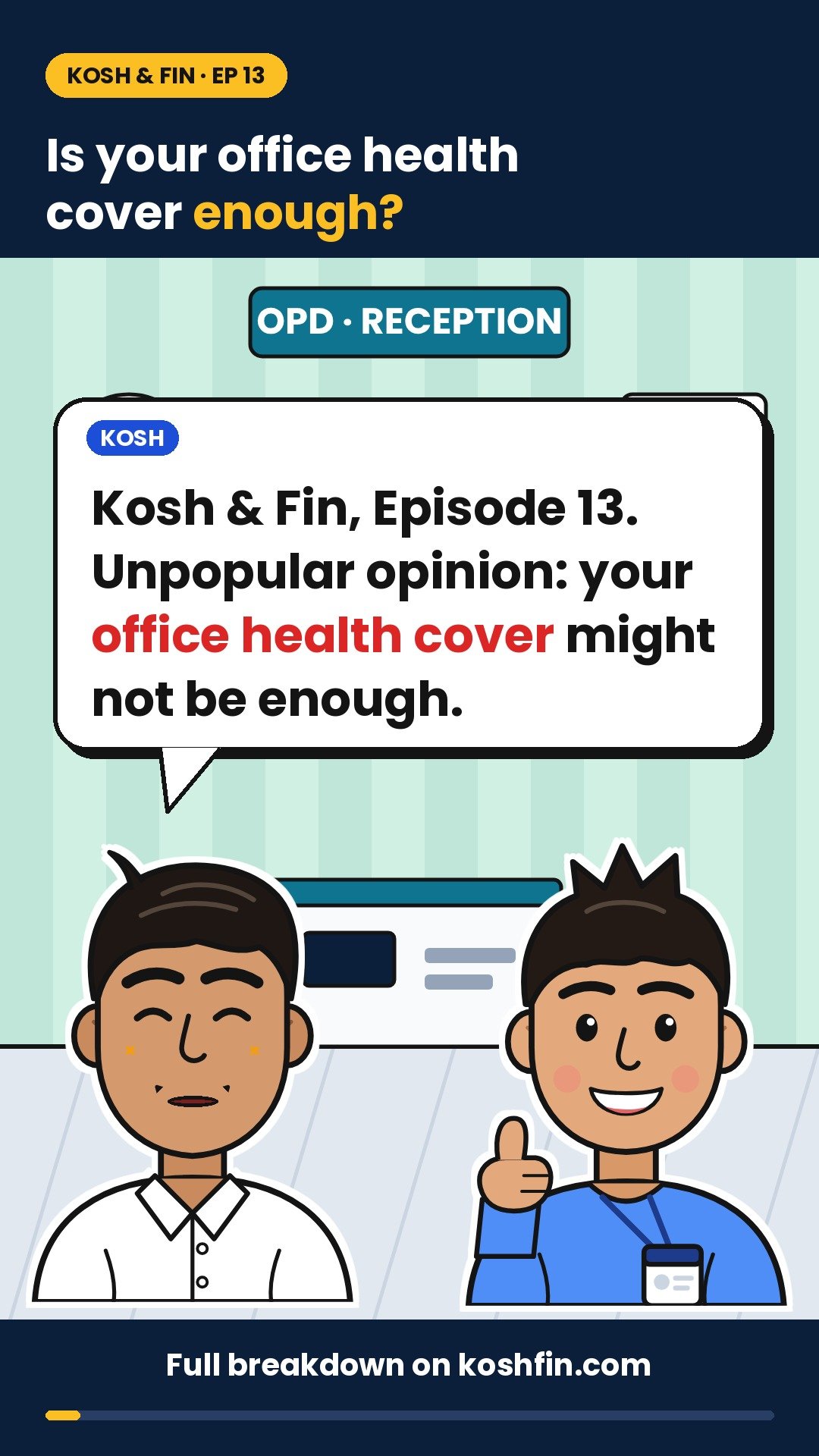
Fin is sure his company’s health cover is all he needs. Kosh explains why office cover is a bonus, not a plan: it ends when the job ends, a family cover can be used up by one big stay, and your own policy is usually cheaper to start young. Watch the reel, then read the full breakdown.
Tap play, sound on. Transcript below.
Why office cover alone can leave a gap
A health policy from your employer (a group health policy) is a great perk. But it belongs to the company, not to you, and that matters in three ways.
| Office (group) cover | Your own policy | |
|---|---|---|
| Who owns it | Your employer | You |
| When you switch jobs, are laid off or retire | Usually ends | Continues as long as you renew |
| Who decides the sum insured | The company | You |
| Premium | Paid by the company (fully or partly) | Paid by you; usually lower when you start young |
| Tax deduction (old regime) | Not for the part your employer pays | Up to ₹25,000 a year under Section 80D |
1. It ends when the job ends
Group cover usually stops on your last working day. If you fall ill between jobs, or after you retire, you may have no cover at all. And buying a fresh policy later, when you’re older or already have a health condition, usually costs more and comes with waiting periods.
2. A family cover is shared
Say your office cover is ₹3 lakh for you, your spouse and your parents. That ₹3 lakh is one pot for everyone. If one person has a big hospital stay that uses up most of it, the others may be left with very little for the rest of the policy year.
3. Your own policy is cheaper to start young
- Start basic. A simple personal health policy on top of your office cover is a good first step; you don’t need a huge one on day one.
- Waiting periods start early. Waiting periods for pre-existing conditions start running from the day you buy, so starting young means they’re over sooner.
- It moves with you. Your own policy doesn’t care which company you work for.
- Leaving a job? Ask HR or the insurer before your last day whether your group cover can be converted into a personal policy.
The tax angle: Section 80D
Under the old tax regime, the premium you pay for yourself, your spouse and your children qualifies for a deduction of up to ₹25,000 a year under Section 80D (₹50,000 if you’re a senior citizen). There’s a separate limit for parents’ premiums. The new tax regime doesn’t allow this deduction, so the tax saving only counts if you file under the old regime. Not sure which regime suits you? Try our income tax calculator.
Keep your own health policy too, and check your office cover’s sum insured and who it covers.
Health cover and an emergency fund work together.
Related reads: Ep 12: direct or regular mutual fund, Ep 11: credit card on UPI and Ep 7: credit score myths on Koshfin. More tools on our tools page.
Education, not insurance or tax advice. Policy terms, waiting periods and tax rules differ and can change; read the policy wording and check the latest rules before you buy or claim.
Reel transcript
Read what Kosh and Fin say
Kosh: Kosh & Fin, Episode 13. Unpopular opinion: your office health cover might not be enough.
Fin: But my company covers me! Why would I buy my own health insurance?
Kosh: Office cover usually ends when you leave the job. Switch jobs, get laid off or retire, and it’s gone.
Fin: Hmm. But the amount is fine, right? Mine is ₹3 lakh.
Kosh: If it’s a family cover, one big hospital stay can use up most of it for everyone.
Fin: So what should I do? Buy a huge policy?
Kosh: Start with your own basic health policy while you’re young and healthy. Premiums are usually lower then.
Fin: Do I at least get a tax break?
Kosh: Under the old regime, yes: up to ₹25,000 a year under Section 80D. The new regime doesn’t allow it.
Kosh: Kosh’s rule: office cover is a bonus, not a plan. Keep your own health policy too.
Frequently asked questions
What happens to my office health insurance when I leave the job?
Group health cover from an employer usually ends on your last working day, whether you switch jobs, are laid off or retire. Some insurers let you convert it into a personal policy if you ask before you leave, so check with HR or the insurer early.
Is a ₹3 lakh office cover enough?
It depends on your city, your family and your health. If it’s a family floater, the sum insured is shared by everyone on it, so one big hospital stay can use up most of it for the rest of the year. That’s why many people keep a personal policy as well.
Why buy my own health policy when I’m young?
Premiums are usually lower when you’re young and healthy, and waiting periods for pre-existing conditions start running from the day you buy. Your own policy also stays with you when you change jobs.
Can I claim a tax deduction on my health insurance premium?
Under the old tax regime, premiums for yourself, your spouse and children qualify for a deduction of up to ₹25,000 a year under Section 80D (₹50,000 if you’re a senior citizen), with a separate limit for parents. The new tax regime doesn’t allow this deduction.
Part of our Kosh & Fin visual stories. New ones every week on Instagram: @kosh_fin