

Indian stock markets open for a special Muhurat trading session on Diwali, Sunday 8 November 2026. Fin thinks this “lucky hour” is a shortcut to Diwali riches. Kosh explains what the session really is, why the trades are real, and how to stay sensible if you take part. Swipe through the comic, then read the full breakdown.




Swipe or use the arrows
Muhurat trading 2026: date and timings
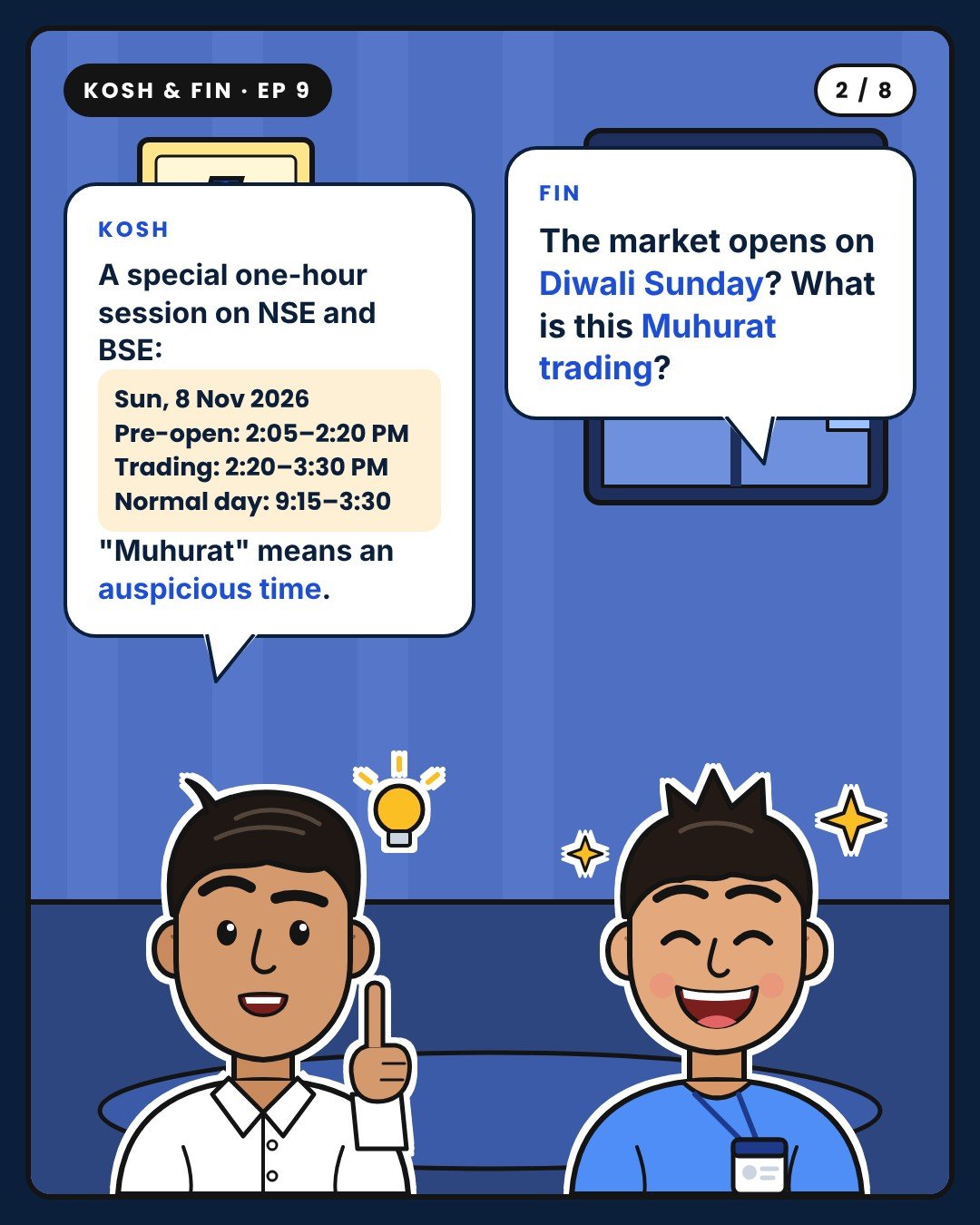
NSE and BSE have both announced a special Muhurat trading session on Diwali, Sunday 8 November 2026. Regular trading is closed that day; only this short session runs. Equity segment timings (IST):
| Session | Time |
|---|---|
| Block deal window | 1:50 – 2:05 PM |
| Pre-open | 2:05 – 2:20 PM |
| Normal trading | 2:20 – 3:30 PM |
| Post-closing session | 3:50 – 4:00 PM |
| For comparison: a regular day | 9:15 AM – 3:30 PM |
That is about 70 minutes of normal trading, against 6 hours 15 minutes on a regular day. Stocks in the closing auction session stop continuous trading a little earlier, at 3:15 PM. IPOs, relisted and illiquid stocks have their own windows, so check your broker’s notice if you plan to trade one of those.
What “Muhurat” means
Muhurat means an auspicious time. Many traders and business families treat Diwali as the start of a new financial year, so the exchanges hold a short session on the day. Some investors place a small token trade to mark the occasion; many simply watch.
The trades are real
Muhurat trading is not a ceremony on a screen. Orders execute just like on any market day: shares you buy are really yours, trades settle normally, and brokerage, exchange charges and taxes apply. If you sell later, the usual capital gains rules apply based on how long you held the shares.
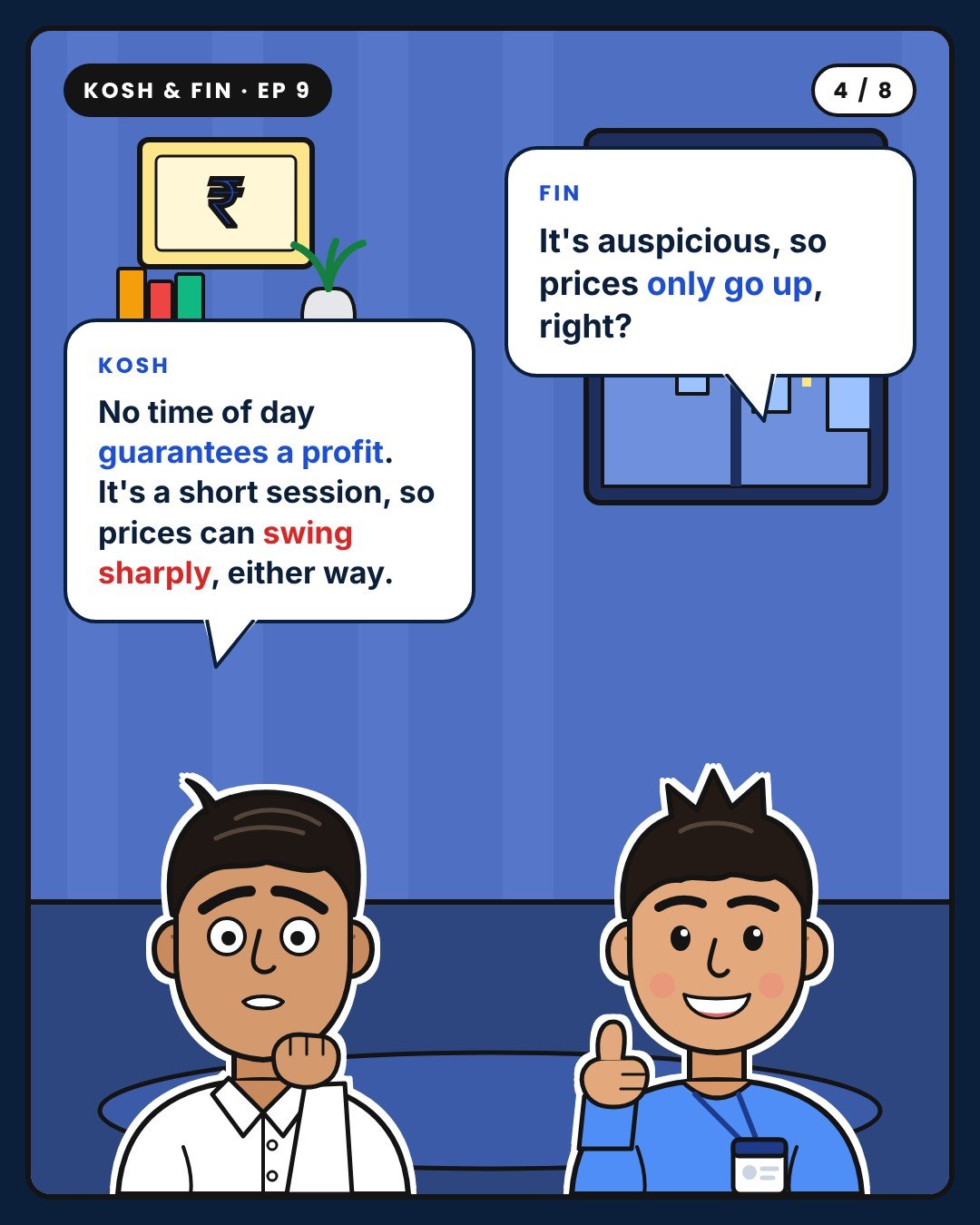
Lucky hour, guaranteed profit? No.
No time of day guarantees a better price or a profit, and a festival does not change that. Because the session is short, prices can swing sharply in either direction. Treat “Muhurat stock picks” you see on social media with caution: they are opinions, not promises.
Worked example: going all in
Fin wants to put his whole ₹50,000 Diwali bonus into one stock during the session. Before dreaming about the upside, look at the downside:
| If the stock moves | Your ₹50,000 becomes | Gain or loss |
|---|---|---|
| +5% | ₹52,500 | +₹2,500 |
| −5% | ₹47,500 | −₹2,500 |
| −10% | ₹45,000 | −₹5,000 |
Charges and taxes come on top. A single stock can move this much on any day, Diwali or not. If a stock wouldn’t make sense for you on a normal Monday, the festival is not a reason to buy it.
If you do want to take part
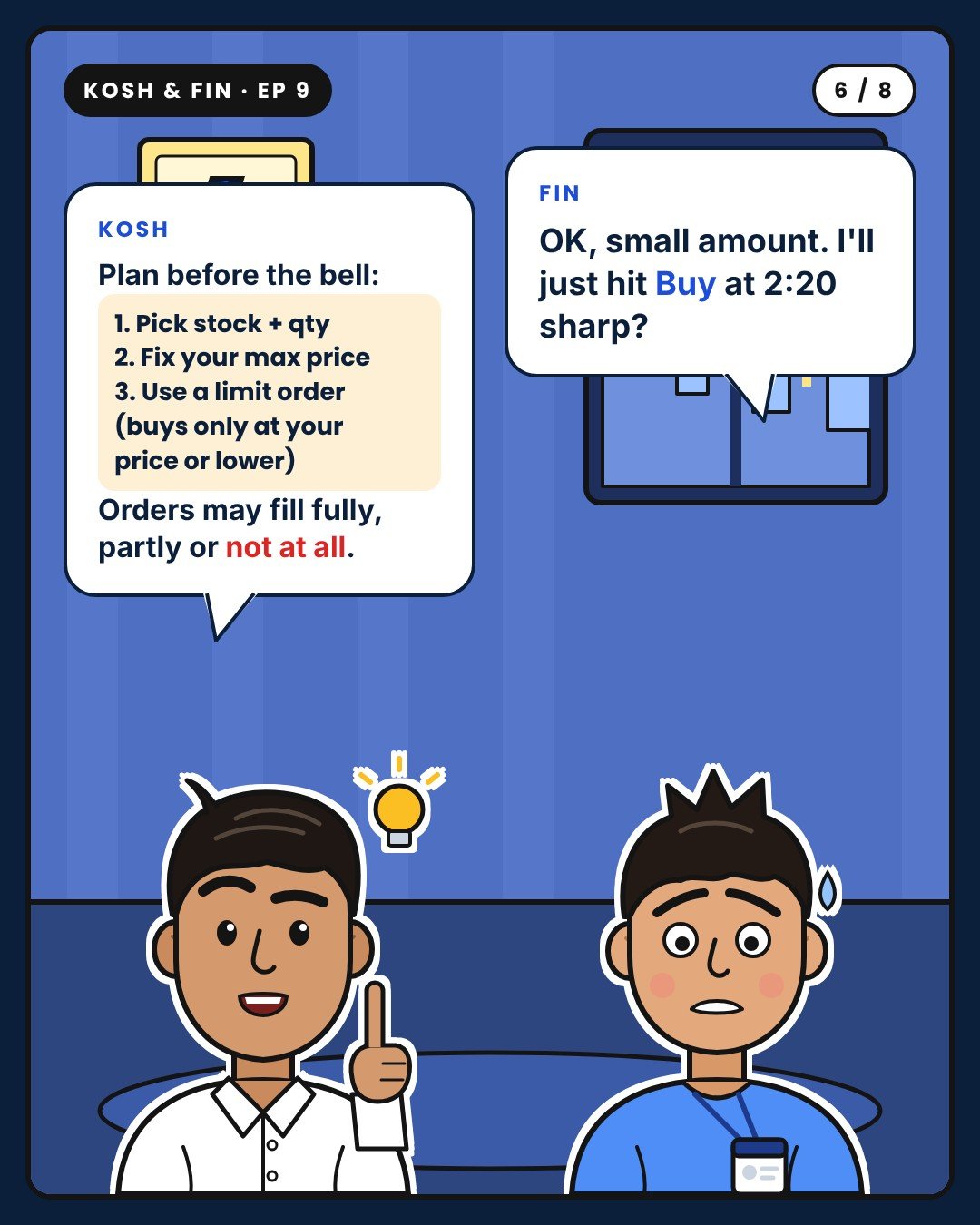
- Decide before the bell: which stock, how many shares, and the highest price you are willing to pay.
- Use a limit order: it buys only at your price or lower, so a sudden jump can’t fill you at a price you didn’t want.
- Expect partial fills: an order may fill fully, partly, or not at all in a short session.
- Keep it small: use an amount you would be comfortable seeing fall, not your emergency fund or your whole bonus.
- Check your broker: make sure it supports the session and the order type you plan to use.
What about my SIP?
Mutual fund transactions don’t necessarily follow the exchange’s Muhurat hours, so check your fund platform’s rules. More importantly, a SIP works by investing regularly over time. There is no need to move its date to a lucky hour.
If you trade on Muhurat, keep it small, use a limit order and buy only what you’d buy on any normal day. Education, not investment advice.
See how a regular amount adds up over time.
Got a Diwali bonus to plan? Read Kosh & Fin Ep 5: Diwali bonus, blow it or grow it, Ep 6: Dhanteras gold, coin, jewellery or digital? and Ep 8: Jio listed at +21%, now what?
Frequently asked questions
When is Muhurat trading in 2026?
Muhurat trading is on Sunday, 8 November 2026, on both NSE and BSE. The pre-open session runs from 2:05 to 2:20 PM and normal trading from 2:20 to 3:30 PM IST.
Are Muhurat trades real trades?
Yes. Trades in the Muhurat session are real: they settle normally, and brokerage, exchange charges and taxes apply, just as on any other trading day.
Is Muhurat trading a good time to make a profit?
No time of day guarantees a profit. The session is short, so prices can swing sharply in either direction. Its value is mainly symbolic. Education, not investment advice.
Should I move my SIP to the Muhurat hour?
No. Mutual fund transactions don’t necessarily follow Muhurat hours, and a SIP works by investing regularly over time, not on a particular date.
Part of our Kosh & Fin visual stories. New ones every week on Instagram: @kosh_fin